
Open-Book Customs Broker Exam: How to Study and Find Answers Fast
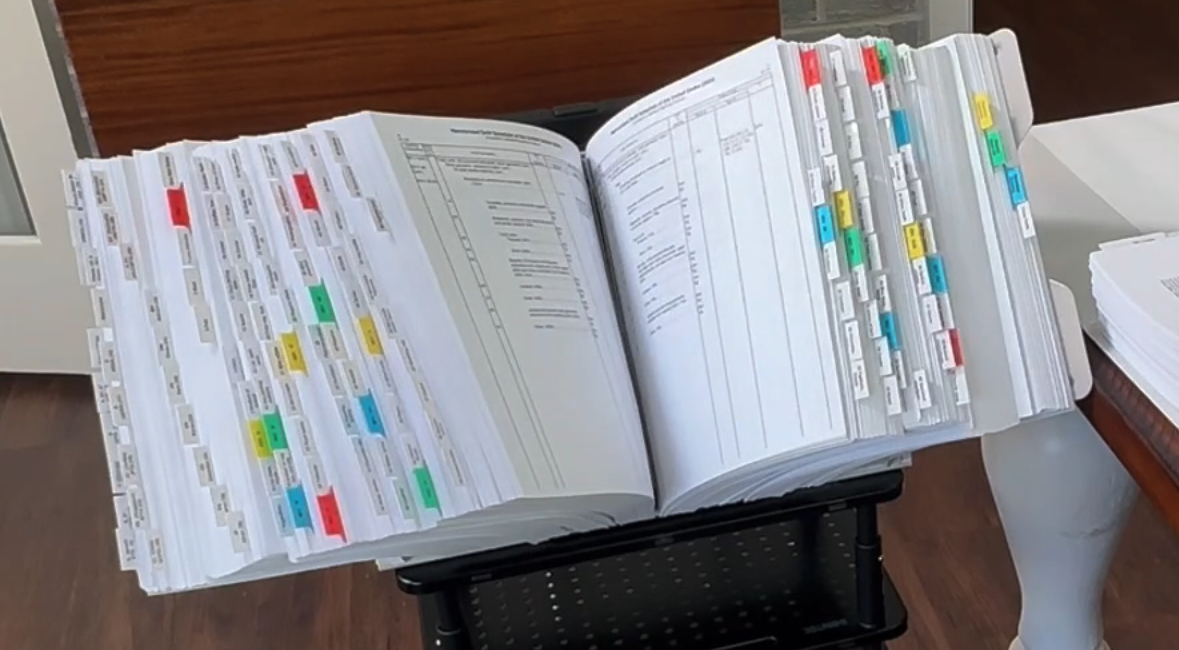
This post is about how to study for the open-book, Customs Broker Exam. Not how long to study, and not whether to use paper or electronic references, but the actual work: how to set up, tab, and highlight your reference materials so that on exam day you can find any answer fast.
The Customs Broker License Exam (CBLE) is an open-book, 80-question, 4.5-hour test given by U.S. Customs and Border Protection, and you’re allowed to bring your printed regulations with you. That sounds like good news. It’s actually the trap. Between Title 19 of the CFR and the Harmonized Tariff Schedule, plus the directives and ACE instructions you’re allowed to bring, you’re looking at more than 6,500 pages. With 80 questions in 4.5 hours, you have a little over three minutes per question, and that’s before you leave yourself any time to review. If you don’t know where to look, open book doesn’t help you at all.
So the exam isn’t really testing what you memorized. It’s testing how fast you can find the answer. That’s good news, because finding things fast is a skill you can build, and this post is how you build it.
Think about driving around your hometown versus a city you’ve never been to. At home, you don’t pull up directions to get to the hardware store. You’ve driven those roads a hundred times, so the map is in your head and you just go. Drop into an unfamiliar city and everything changes. You’re stopping at every intersection, checking your phone, missing turns. Studying for an open-book exam is the work of turning those 6,500 pages from an unfamiliar city into your hometown.
In this post
- Why open book doesn’t mean easy
- Getting the right materials and giving them a home
- Tabbing so you can reach any section in seconds
- The five-color highlighting system
- Studying to build the map instead of memorizing
- Practicing your lookups under time
Open book doesn’t mean easy
Most people who fail the CBLE don’t fail because they didn’t know the material. They fail because they couldn’t get to it in time. That’s the part the open-book format hides.
Run the math. More than 6,500 pages of allowable references. Eighty questions. Four and a half hours. That’s about three minutes and twenty seconds per question if you spend every second answering and never look up from the page, and you do need to look up, because most questions send you into the books to confirm a deadline, a dollar figure, or which entry type applies. A question you know cold might take 30 seconds. A classification question you have to reason through the HTSUS can eat ten minutes if you’re not careful. The time pressure is real, and it’s why so many well-prepared people walk out having only finished 60 of the 80 questions.
CBP does give you a digital copy of the references on exam day with a basic search function. But it’s slow to page through large files on a single screen, and CBP itself recommends that you bring your own paper references as a backup. In practice, the people who move quickly are working from paper they set up themselves.
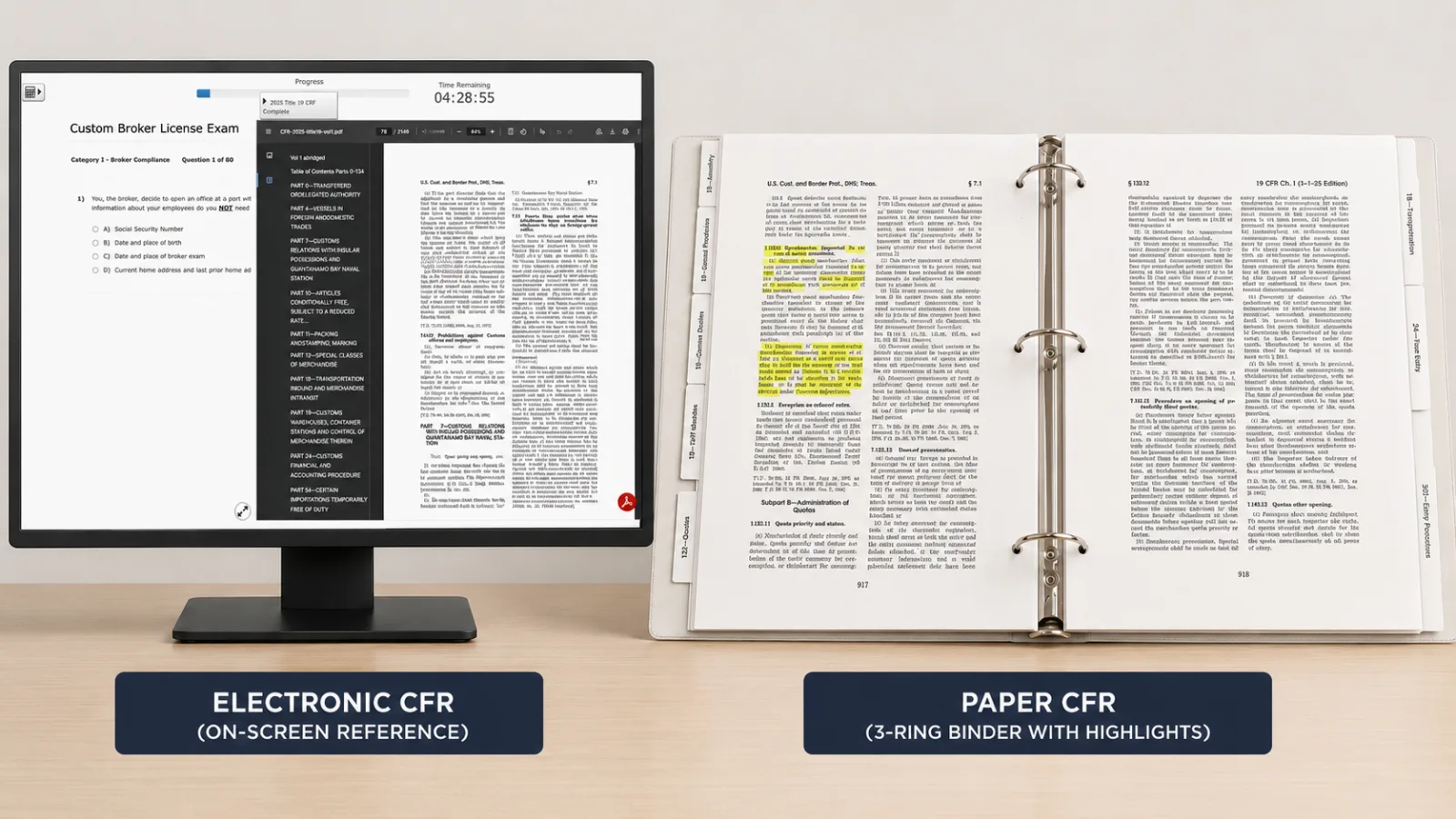
This is the hometown idea again. Speed on exam day comes from familiarity you built in the weeks before, not from a search box you’re using for the first time under pressure. If you’re still on the fence about paper versus electronic, that’s a separate decision worth its own read, and I’ve written about why paper wins on lookup speed elsewhere. For the rest of this post, I’m going to assume you’ve committed to paper, because the system below is built around it.
Step 1: Get the right materials and give them a home
Before you can build the map, you need the books. CBP lists the exact reference materials and editions for each exam on the CBLE Registration Information page, and they change from exam to exam as the regulations update. For recent exams, the required set has included the Harmonized Tariff Schedule (Basic Edition), Title 19 of the CFR (the annual edition, Parts 1 to End), the ACE Entry Summary Instructions, the Right to Make Entry directive (3530-002A), and the ACE Summary Business Rules and Process Document. Check the registration page for your specific exam so you’re studying from the same editions you’ll test on.
Once you have them, give them a permanent home. This sounds trivial. It isn’t. The single most useful thing you can do early is decide where each book lives and never change it, because your hands learn the setup the same way they learn a keyboard. If the HTSUS is always on your left and the CFR is always on your right, you stop thinking about which book to reach for and you start reaching automatically. Whether you use the old 12-section catalog rack, a wheeled cart, or a row of heavy-duty binders matters less than picking one and sticking with it for the whole 12 to 14 weeks you’re studying a little every day.
Step 2: Tab so you can reach any section in seconds
Tabs are the index your brain actually uses on exam day. A good tabbing system means a question about bonds sends your hand to the same tab every time, without scanning.
Build your tabs around the structure of the materials, not around a list someone handed you. For the CFR, that means tabbing by Part, because the Parts are how the regulations are organized and how questions are framed. The Parts you’ll reach for most often include 111 (customs brokers), 113 (bonds), 141 (entry of merchandise), 152 (classification and appraisement of merchandise), 174 (protests), and 190 (drawback). For the HTSUS, tab the General Rules of Interpretation and each Section and Chapter, because classification questions live there and you’ll be in that book constantly.
Then add a second, lighter layer of topic tabs for the high-frequency subject areas CBP tests again and again: broker compliance, bonds, valuation, classification, recordkeeping, and entry summary. These are the categories CBP publishes as typical exam content, so building tabs that match them means your physical setup mirrors the way the exam is organized.
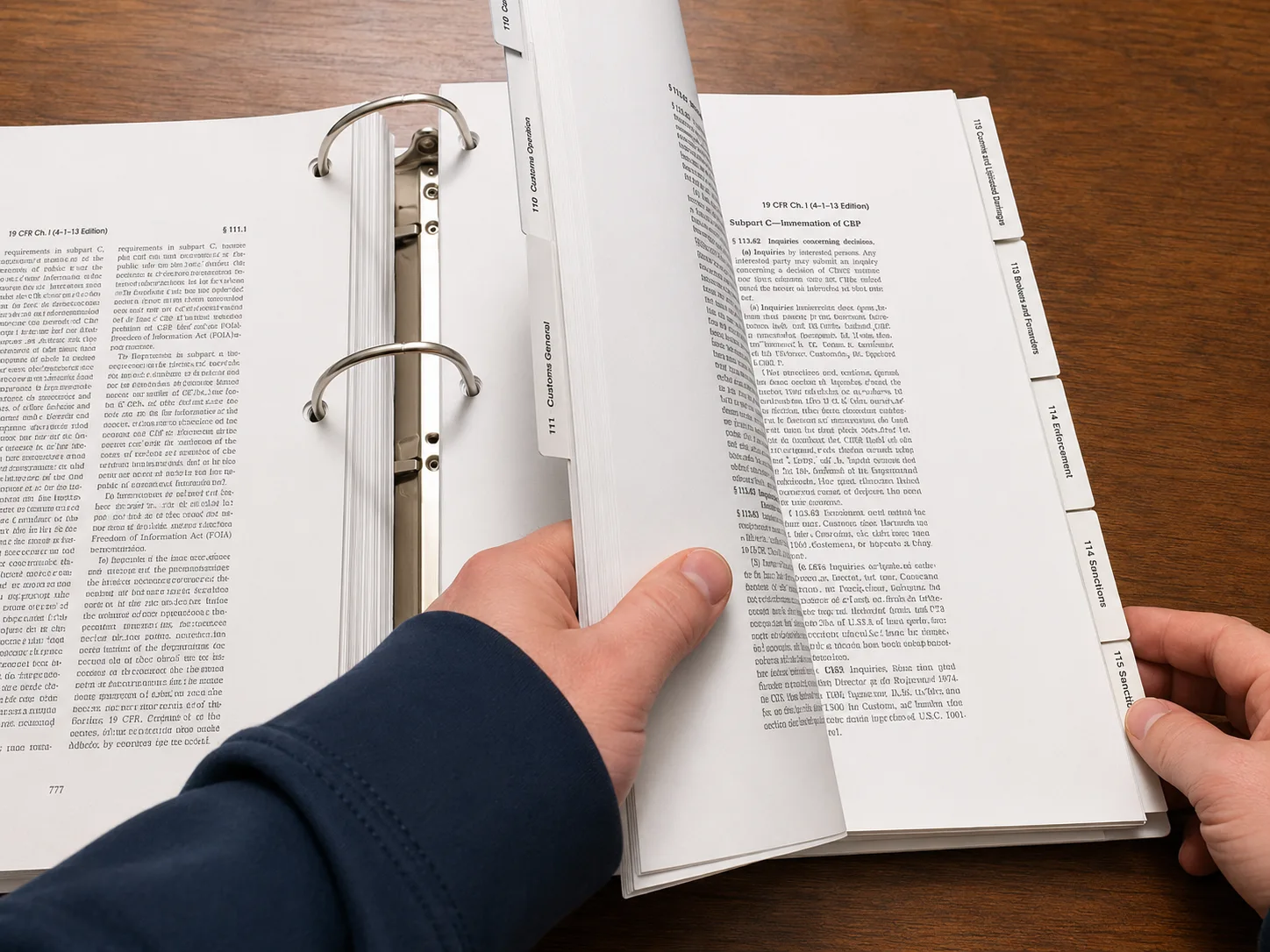
You can buy pre-made tab sets, and there’s nothing wrong with that. What they can’t do is teach you the layout. When you place the tabs yourself, you’re handling each Part, reading the headings, and forming a memory of where it sits in the book. That placement is studying. From experience, the brokers who tabbed their own books navigate faster than the ones who bought a finished set and never built the map in their head.
One note on the rules, and it’s good news. Printed reference materials are allowed, and you can mark them up however you like. Tabs, highlighting, handwritten notes in the margins, your own annotations on the page, all of it is fair game. The only hard line is that you can’t bring electronic devices of your own into the exam. So set your paper up exactly the way that helps you find answers fastest, and confirm the allowable editions for your specific exam on CBP’s registration page so you’re working from the same books you’ll test on.
Step 3: The five-color highlighting system
Highlighting is where most people waste the most effort, because they highlight everything. If the whole paragraph is yellow, nothing stands out, and you’ve spent an hour turning a black-and-white page into a slightly slower black-and-white page. The point of highlighting isn’t to mark what’s important. Almost all of it is important. The point is to make specific kinds of information jump off the page so your eye lands on them instantly.
That’s why I teach a five-color system. Each color means one category, and you use it consistently across every book. Once your eye is trained, you don’t read the paragraph to find the deadline. You look for blue.
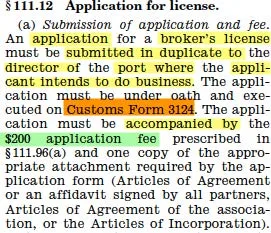 Blue is for time periods and deadlines. Tendays, 180days, the liquidation period, the protest window. Time-based questions are everywhere on this exam, and a deadline you can spot by color is a question you can answer in seconds.
- Green is for money. Dollar amounts, duty figures, fees, bond amounts, the merchandise processing fee and harbor maintenance fee thresholds. When a question asks for a number with a dollar sign, your eye goes togreen.
- Pink is for penalties and consequences. Liquidated damages, penalty tiers, the difference between negligence and fraud. These show up constantly in fines and penalties questions, and they’re easy to confuse under pressure, so they get their own color.
- Orange is for forms and document numbers. CBP form numbers, entry type codes, the specific document a process requires. Orange separates the “which form” detail from everything around it.
- Yellow is for general key terms and definitions. The defined term, the controlling phrase, the one word in a sentence that changes the answer.
Here’s why it works in practice. Picture a recordkeeping or valuation paragraph that contains a deadline, a dollar threshold, and a penalty all in the same dense block of text. Read cold, you’d have to parse the whole thing to answer “what’s the deadline for keeping these records?” With the system, the deadline is the only blue mark in the paragraph. You find it without reading the sentence around it. You’ve turned a reading task into a spotting task, and spotting is faster.
A word on what not to do, because I learned this the hard way. When I was preparing, I highlighted far too much at first. I’d run a highlighter down half a page because it all seemed to matter, and it did, but a page that’s half-highlighted is no easier to navigate than a page with no highlighting at all. Highlight with a strategy. Mark the specific words you need, in the color that tells you what kind of word it is, and leave the rest alone. The white space is part of the system.
Step 4: Study to build the map, not to memorize
Here’s the shift that ties all of this together: when you study, study inside your books, not away from them.
It’s tempting to read a study guide or watch a video on the couch, away from the heavy binders, and tell yourself you’ll do the lookups later. Don’t. Every time you look something up in your own tabbed, highlighted references, you’re reinforcing two things at once, the concept and the location. You learn what the rule is and where it lives, together, and on exam day you need both. Studying away from the materials teaches you the concept and leaves the map blank.
This is also why a little every day beats a long weekend session, and it’s worth reading the full case for an hour a day over the weekend marathon if you haven’t set your cadence yet. Each daily session is another rep through the books, another reinforcement of where the bond provisions sit and how the HTSUS Sections flow. Frequent trips through the same pages are what move the map from “I think it’s somewhere in Part 113” to “it’s the third tab, top of the right page.” Stick with one topic until it genuinely clicks before you move to the next, so you’re building solid ground instead of stacking fuzzy understanding you’ll have to relearn later.
Step 5: Practice finding answers under time
A map you can’t read under pressure isn’t finished. The last piece is practicing the lookups themselves, against the clock.
Before you sit down for a full 4.5-hour practice exam, do shorter, targeted lookup drills. Take a single past exam question, find the controlling regulation in your books, and time yourself. Your target is to locate the answer in under three minutes, because that’s the pace the real exam demands. Do enough of these and something useful happens: you stop hunting and start knowing. The bonds question goes to the bonds tab automatically, and the green highlight gives you the dollar figure before you’ve finished reading the question.
CBP publishes past exams and answer keys, and they’re the best practice material there is, straight from the source. Use them for your drills before you use them for full timed runs.
One mistake to avoid, because I made it myself. Early on, I jumped straight to full timed practice exams, scored myself, did badly, got discouraged, and quit for the night, then did the same thing the next day. That’s a terrible learning cycle. It teaches you that you’re slow without teaching you how to get faster. Drill the lookups first, in small reps, until the navigation is automatic. Then the full timed exams become a measure of progress instead of a nightly discouragement. The other half of that battle is exam-day pacing, knowing when to let a hard question go, which is its own skill worth understanding if you’ve ever run out of time on a practice exam.
Frequently asked questions
Is the customs broker exam open book?
Yes. The CBLE is an open-book, 80-question, 4.5-hour exam, and you may bring printed reference materials including Title 19 of the CFR and the HTSUS. It’s given electronically, and CBP provides a digital copy of the references with basic search, but recommends you bring your own paper as a backup.
What reference materials can I bring to the exam?
CBP lists the exact materials and editions for each exam on the CBLE Registration Information page, and they update from exam to exam. Recent exams have allowed the HTSUS (Basic Edition), Title 19 CFR (annual edition), the ACE Entry Summary Instructions, the Right to Make Entry directive, and the ACE Business Process Document. Always confirm the editions for your specific exam date.
Can I tab and highlight my books? Can I write notes in them?
Yes. You can tab, highlight, and write your own handwritten notes anywhere in your printed reference materials. There’s no restriction on marking up the paper you bring. The one thing you can’t bring is your own electronic device, so the only references you can annotate are the printed ones. Set them up however helps you find answers fastest.
Do I need to buy pre-made tabs?
No. Pre-made tab sets are fine and save time, but placing the tabs yourself is part of how you learn the layout of the books. If you buy them, still spend time with each Part as you set them so you’re building the mental map, not just the physical one.
How long does it take to tab and highlight everything?
Plan for it to happen across your study period rather than in one sitting. Tabbing and highlighting aren’t separate from studying, they are studying, because the act of marking the pages is what teaches you where things are.
See how we set up the books
That hometown map of the regulations is the whole game on an open-book exam. The faster you can find the answer, the more of those 80 questions you’ll actually get to, and building that speed is a system anyone can follow with enough reps in well-organized books.
If you want to see how we set it up, the free preview of the Customs Broker Geek course walks through exactly this. It covers the study setup and materials in Section 1 and the broker compliance section in Section 2, so you can see the structure and the approach before you commit to anything. Take a look at the free preview and set your books up right from the start.
Nate Holsing is a licensed customs broker who has been teaching customs broker exam prep since 2014. He runs Customs Broker Geek’s 14-week online CBLE course.